
Why Middle Market Medical Outpatient Buildings With Operating Partners
Viewpoints: Q2, 2024
By Steen Watson, President, Anchor Health Capital
Anchor Health Capital (formerly known as Chestnut Funds) manages real estate investment funds that invest in distinct strategies but with a common denominator of investing in middle market real estate alongside operating partners. Chestnut Funds was founded in 2012 after the partners’ collective experience revealed market inefficiencies, that if addressed, could provide meaningful investment opportunities for investors. Now, with five multi-asset funds under management and fundraising for our third medical outpatient building (MOB) fund underway, we remain true to our founding investment thesis.
The Middle Market Value Proposition
Anchor views middle market real estate as being properties with a value of $5 million to $20 million and an equity investment of approximately $1 million to $5 million. In our experience, this size range is typically too small for many institutional investors but too large for sponsors or developers to easily fund with their own or self-sourced capital. Also in our experience, the number of properties in this size range is large and the overall market of middle market assets is fragmented. For example, according to sales comparison data available from GreenStreet, only 22% of the healthcare real estate transactions for 2024 to date were assets greater than $20 million. We believe it is this fragmentation and the scarcity of institutional capital targeting these size assets that create inefficiencies that allow for attractive investment opportunities.
By focusing on middle market real estate, Anchor makes investments in an inefficient market where pricing advantages exist, creates value through the ownership period, and sells in a more efficient market. This is typically done by creating stabilized properties that attract capital desirous of secure, long-term cash flow or by looking to aggregate assets in portfolios to attract institutional capital. By consolidating a considerable number of properties into a single transaction, institutional investors can achieve cost efficiencies across various aspects of acquisitions and asset management. The economies of scale associated with portfolio acquisitions allow for the reduction of fixed acquisition costs and a more diversified risk profile for investors seeking to mitigate market-specific volatilities.
Insights supporting our investment thesis around middle market MOB pricing can be found in available Class A MOB transaction data. As transaction amount increases, the available data indicates that cap rate decreases (with some exceptions), driving higher asset value. Reasons for this that we have identified through our investing efforts include the inefficiencies of deploying capital into smaller transactions, higher competition for larger assets into which investors can deploy larger amounts of capital, and the perceived “safety” of larger assets. With proper underwriting and exit strategies that seek to sell assets in a portfolio or at a higher value than when acquired, it is our belief that the perceived safety advantage of larger assets may not hold up to analysis due to acquisition prices for those assets.

Sources: Revista, Anchor Health Properties
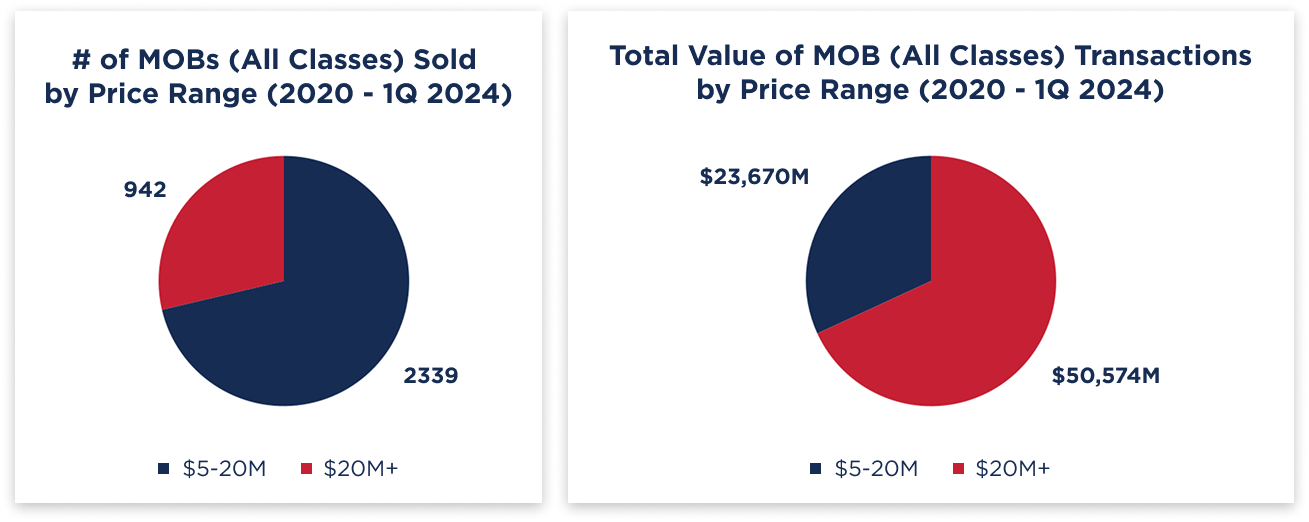
An analysis of MOB transactions since 2020 highlights the fragmented nature of the market for MOBs with a value lower than $20M. Sales of assets between $5 million and $20 million comprise approximately 70% of the total sale transactions. But assets in this value range comprise only 32% of the total sales dollar volume. This means almost 70% of capital invested in the MOB sector was in assets with larger than $20 million even though there are far fewer assets in this size range
Sources: Revista, Anchor Health Properties
Since part of the pricing inefficiency related to middle market real estate relates to the lack of liquidity for smaller properties, Anchor focuses on properties located in larger, more dynamic markets that have stronger demand drivers, that in turn, create a more diverse and robust economy. Our view is that investment liquidity is typically greater in larger, more dynamic markets.
Working with Operating Partners
Anchor cultivates relationships and invests with operating partners for many reasons. Operating partners are typically commercial real estate developers and sponsors with a focus on and expertise in a particular market. Oftentimes, these partners have vertically integrated platforms allowing for efficient execution of an investment strategy. Due to Anchor’s exclusive and distinct focus on middle market real estate, we can create long-lasting strategic partnerships with operating partners with investment strategies aligned with ours.
Operating partners have very particular, valuable expertise, whether that is asset type, geographic market, or investment specialization, such as a focus on development or value-add strategies.
Operating partners’ specialization provides access to a diverse and robust pipeline of opportunities.
Operating partners with competencies that include construction management, leasing, or property management, allow Anchor to be confident in the execution of the investment strategy during the development, repositioning, and management portions of the investment life cycle.
Operating partners have relationships with service providers to help deliver projects in alignment with a project’s business plan and budget.
What’s in it for investors?
By creating middle market real estate investment vehicles, Anchor seeks to provide investors with MOB investment opportunities that are otherwise difficult to access, particularly in an aggregated fashion. Investors may find our strategy appealing because of middle market real estate’s pricing advantages and our robust pipeline made possible by operating partner relationships. And investors can benefit from the rigor of Anchor’s investment processes and investor reporting.
Anchor will continue to source and execute investments in line with its investment thesis around the benefits of middle market MOB real estate. If you are interested in learning more, please reach out to Steen Watson at steen@anchorhealthcapital.com.
Sources
Anchor Health Properties. MOB Transaction Data for 3Q 2023 – 1Q 2024 Sourced from Commercial Real Estate Brokers
Green Street. CRE Transaction Data. (Accessed June 2024)
Revista. MOB Transaction Data. (Accessed March 2024)
Disclaimer
The information contained in this document is intended for informational purposes only and is not intended to provide personalized investment advice or to constitute an offer or solicitation to buy or sell securities or interests in any investment. The charts, graphs, and other information contained herein should not serve as the sole determining factor for making investment decisions.
This document cannot be reproduced, shared, or published in any manner without the prior written consent of Anchor Health Capital (“Anchor”). Unless otherwise indicated, all statements and expressions in this paper are the sole opinion of Anchor and are subject to change without notice. Predictions, forecasts, or outlooks described or implied are forward-looking statements based on certain assumptions, which may prove to be wrong, and/or other events, which were not taken into account, may occur. Any predictions, forecasts, outlooks, opinions, or assumptions should not be construed to be indicative of actual events, which will occur. The opinions and data in this newsletter have been obtained from sources believed to be reliable. Anchor does not warrant the accuracy or completeness of such and accepts no liability for any direct or consequential losses arising from its use.
Investing in securities involves risk of loss and should not be based solely on marketing materials including the information provided herein. Further, depending on the different types of investments there are varying degrees of risk. Private Funds managed by Anchor and their investors should be prepared to bear investment loss, including loss of original investment. There is no assurance that any specific investment or investment strategy utilized by Anchor will be either suitable or profitable for your portfolio. Anchor does not provide personalized or customized investment advice, therefore you are urged to discuss your personal investment situation with the financial professional of your choice before making or changing an investment in a Anchor offering.
Because of the inherent risk of loss associated with investing in any type of securities, Anchor is unable to represent, guarantee, or even imply that its services and methods of analysis can or will predict future results, successfully identify market tops or bottoms, or insulate you from losses due to market corrections or declines.