
Freestanding Emergency Departments: Expanding Emergency Access Through Specialty Healthcare Real Estate
Anchor Viewpoints: June 2026
By Steen Watson, President, Anchor Health Capital
As healthcare delivery continues to move beyond traditional hospital campuses, freestanding emergency departments (FSEDs) are emerging as a specialized real estate sector designed to extend 24/7 emergency care into growing markets. FSEDs are emergency-care facilities located apart from a main hospital campus and may operate as either hospital-affiliated off-campus emergency departments or independent emergency centers.
Within the broader specialty healthcare real estate sector, FSEDs occupy a distinct role. They provide more acute medical services than urgent care centers, are smaller and more targeted than full-service hospitals, and are often designed to help health systems expand access in high-growth suburban and select rural markets. For investors, FSEDs reflect the continued movement toward purpose-built facilities that support specialized clinical operations.
A Growing Segment of the Emergency Care Market
Emergency care remains a major component of the U.S. healthcare system, with approximately 140 million emergency department visits recorded in 2021(1). FSEDs have expanded as emergency department volumes have grown, and consumer demand for more convenient care settings emerged.
The U.S. freestanding emergency department services market was estimated at $16.55 billion in 2024 and is expected to reach $23.35 billion by 2030, representing a projected 5.93% CAGR from 2025 to 2030(2). The number of facilities has also increased substantially over the past two decades. Recent data indicates that the number of FSED properties increased from only 50 in 2001 to 841 in 2022, with those facilities accounting for more than 13.7 million patient visits(3). Together, these trends point to the growing role of FSEDs within the broader emergency care and outpatient healthcare landscape.
Why Freestanding Emergency Departments Are Expanding
Rising Demand for Convenient Emergency-Care Access
Patients today increasingly expect healthcare to be closer to home, faster, and easier to navigate. FSEDs respond to that demand by offering around-the-clock emergency care in locations that may be more accessible than a hospital campus, particularly in high-growth suburban markets where population expansion can outpace hospital infrastructure.
Expansion of Hospital Outpatient and Ambulatory Strategies
FSED growth also aligns with health systems’ broader outpatient strategies. As systems shift more services into community-based settings, FSEDs can help extend a system’s brand, capture patient demand, and create access points that connect back to affiliated hospitals and service lines.
Support for Emergency Access in Underserved Markets
FSED growth is also supported by broader efforts to improve access to emergency and urgent care in communities where traditional hospital infrastructure may be limited. Federal grant programs and rural health initiatives can help lower capital barriers, support workforce capacity, and expand care access in underserved markets.
What Investors Should Understand
For healthcare real estate investors, FSEDs offer exposure to a specialized property type supported by strong operator demand and long-term healthcare delivery trends. Because these facilities are tied to emergency-care access, they can play an important role in a health system’s broader market strategy, particularly when located in areas with population growth, limited nearby hospital infrastructure, or increasing demand for outpatient access points.
FSEDs may also benefit from favorable operating characteristics compared to lower-acuity care settings. Because they are licensed for emergency services, reimbursement rates are generally higher than traditional urgent care centers. This can improve provider profitability, supporting higher real estate values when paired with strong operators and appropriate lease structures.
These properties often require significant clinical infrastructure, including diagnostic imaging, trauma-capable treatment areas, ambulance access, lab space, backup power, and layouts designed for emergency workflows. When combined with long-term absolute net leases, health system alignment, and strong market fundamentals, FSEDs may offer investors access to a highly specialized segment of healthcare real estate with meaningful strategic value.
Case Study: Hybrid FSED and Urgent Care Programmatic Expansion
Anchor Health Properties has experience supporting the development of hybrid freestanding emergency department and urgent care facilities through build-to-suit projects designed around health system needs.
In one programmatic expansion, Anchor served as a development partner and real estate advisor for a growing pipeline of hybrid FSED and urgent care centers in the Phoenix, Arizona MSA. The facilities were developed in strategic retail locations with high visibility and proximity to local hospitals, helping extend the health system’s community presence.
Representative program features included:
12,000–20,000 square feet per facility
Approximately 10-month build timeline
20-year lease structure with fixed annual escalations
Pre-leased, build-to-suit development approach
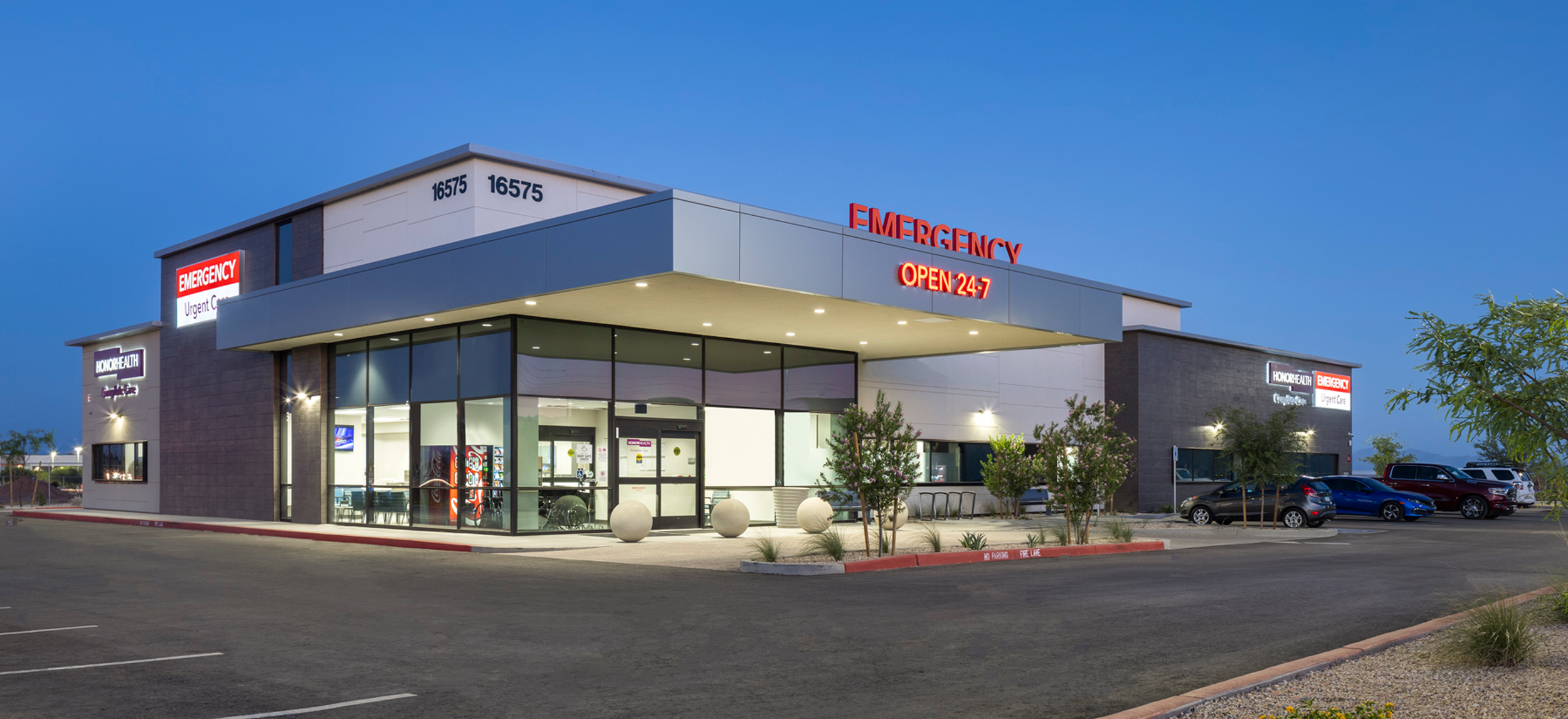
These types of projects illustrate the role FSEDs can play within a broader healthcare real estate strategy. For health systems, they can serve as access points within a coordinated network, designed to reach new communities. For investors, they can provide exposure to community-enhancing, mission critical healthcare assets.
Conclusion
Freestanding emergency departments represent a growing and increasingly relevant segment of healthcare real estate. Their expansion reflects several durable healthcare trends: demand for convenient access, the movement of care beyond the hospital campus, and federal support for improved emergency care access in rural communities.
For Anchor Health Capital, FSEDs fit within a broader thesis around specialty healthcare real estate: investing in purpose-built facilities that support essential care delivery, deepen relationships with healthcare operators, and reflect the continued shift in how and where care is delivered.
Sources
1: Grand View Research, U.S. Freestanding Emergency Department Market Size, Share & Trends Analysis Report.
2: Grand View Research, U.S. Freestanding Emergency Department Market Size, Share & Trends Analysis Report.
3: Emergency Medicine Network / National Emergency Department Inventories-USA, Freestanding EDs: 2022 FSED Statistics.
Disclaimer
The information contained in this document is intended for informational purposes only and is not intended to provide personalized investment advice or to constitute an offer or solicitation to buy or sell securities or interests in any investment. The charts, graphs, and other information contained herein should not serve as the sole determining factor for making investment decisions.
This document cannot be reproduced, shared, or published in any manner without the prior written consent of Anchor Health Capital (“Anchor”). Unless otherwise indicated, all statements and expressions in this paper are the sole opinion of Anchor and are subject to change without notice. Predictions, forecasts, or outlooks described or implied are forward-looking statements based on certain assumptions, which may prove to be wrong, and/or other events, which were not taken into account, may occur. Any predictions, forecasts, outlooks, opinions, or assumptions should not be construed to be indicative of actual events, which will occur. The opinions and data in this newsletter have been obtained from sources believed to be reliable. Anchor does not warrant the accuracy or completeness of such and accepts no liability for any direct or consequential losses arising from its use.
Investing in securities involves risk of loss and should not be based solely on marketing materials including the information provided herein. Further, depending on the different types of investments there are varying degrees of risk. Private Funds managed by Anchor and their investors should be prepared to bear investment loss, including loss of original investment. There is no assurance that any specific investment or investment strategy utilized by Anchor will be either suitable or profitable for your portfolio. Anchor does not provide personalized or customized investment advice, therefore you are urged to discuss your personal investment situation with the financial professional of your choice before making or changing an investment in a Anchor offering.
Because of the inherent risk of loss associated with investing in any type of securities, Anchor is unable to represent, guarantee, or even imply that its services and methods of analysis can or will predict future results, successfully identify market tops or bottoms, or insulate you from losses due to market corrections or declines.