
Anchor Viewpoints: October 2026
By Steen Watson, President, Anchor Health Capital
Behavioral health has become an increasingly important part of the U.S. healthcare system as demand for mental health and substance use treatment continues to grow. The facilities supporting this sector span a wide range of care settings. That breadth reflects greater awareness and broader access, as well as a more diverse range of treatment options.
In this edition of Anchor Viewpoints, we examine the behavioral health sector and the factors supporting its continued growth. We also look at the challenges facing providers and the real estate considerations that matter most, including operator alignment and tenant credit.
What Are Behavioral Health Facilities?
Behavioral health facilities provide treatment for mental health conditions and substance use disorders. Depending on the care model, services range from outpatient therapy and crisis intervention to residential treatment and inpatient psychiatric care. Intensive outpatient and partial hospitalization programs fill the space between those levels of care.
These facilities support a range of clinical needs, from stabilization and therapy to longer-term recovery. Outpatient services may be delivered in clinical or medical outpatient settings, while residential treatment centers and inpatient psychiatric hospitals generally require more specialized facilities designed around longer patient stays and more intensive clinical operations.
Market Growth and Persistent Demand
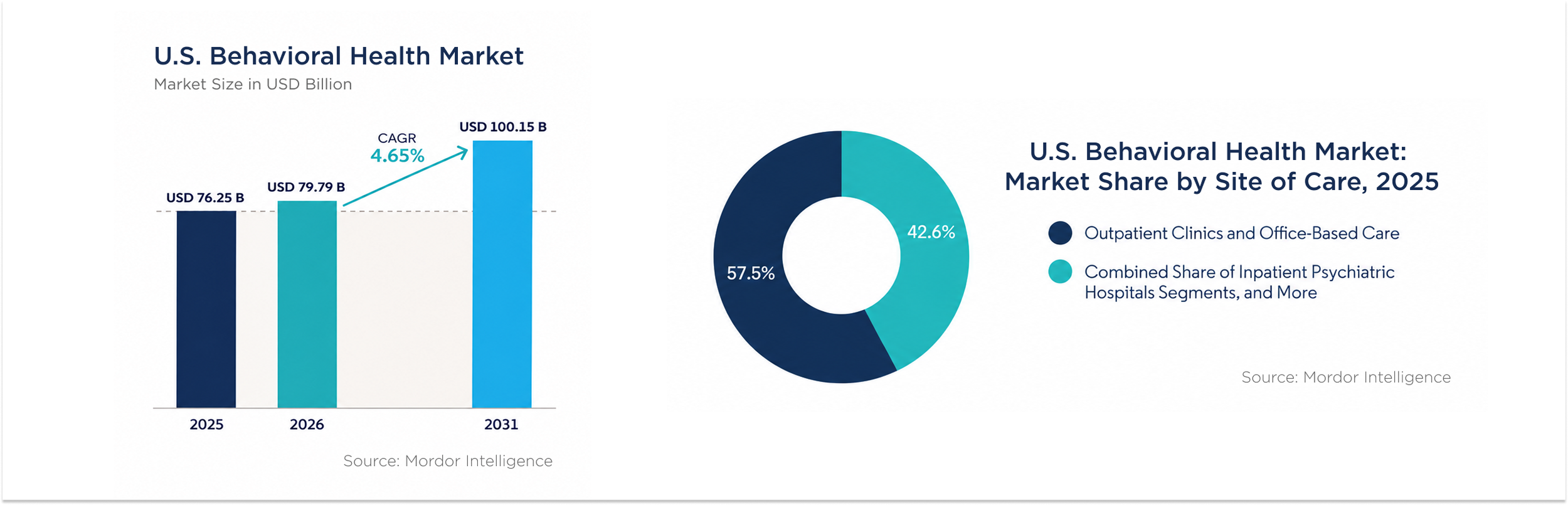
The U.S. behavioral health market is estimated at nearly $80 billion in 2026 and is projected to reach $100 billion by 2031, representing a 4.65% compound annual growth rate. Behavioral health utilization has also increased substantially, rising an estimated 62.6% between 2018 and 2024, including routine visits as well as crisis and follow-up care.
The demand drivers for this specialized care are significant across the country. According to the Substance Abuse and Mental Health Services Administration (SAMHSA), 23.4% of U.S. adults experienced a mental illness in 2024. SAMHSA also reports that nearly 50 million Americans age 12 or older experienced a substance use disorder in 2024.
Growth is also occurring across several care settings. Outpatient clinics and office-based care represented 57.45% of the U.S. behavioral health market in 2025, while partial hospitalization and intensive outpatient programs are projected to be among the faster-growing segments through 2031.
Factors Supporting Growth: Access, Coverage, and Reimbursement
Several trends are supporting greater use of behavioral health services. Awareness has increased and the perceived stigma has declined. Behavioral and physical healthcare are also becoming more closely integrated, while telehealth and other community-based models have expanded access.
Broader insurance coverage has also played an important role in expanding access to behavioral health services. The Integra Realty Resources Behavioral Health Facilities Report identifies mental health parity legislation and changes in insurance coverage as significant long-term drivers of sector growth. Federal parity requirements, which require health plans to cover mental health and substance use treatment on terms that are no more restrictive than their coverage for medical and surgical care, and the Affordable Care Act helped broaden coverage for mental health and substance use treatment across a wider range of patient populations.
Additionally, reimbursement policies continue to influence how and where behavioral health services are delivered. As coverage has expanded across treatment settings, from outpatient to residential care, providers have been able to offer a broader range of care models and reach more patients. Payer mix and reimbursement therefore remain important considerations for providers entering or expanding within a market.
Challenges Accompanying Growth
Strong demand does not eliminate the operational challenges facing behavioral health providers. Licensing requirements and state-level regulations can create meaningful barriers to entering new markets or developing new facilities. Startup costs add further hurdles.
Insurance reimbursement has improved but remains a challenge. Parity laws have broadened coverage, yet payment still lags. The Mental Health Parity Index, developed by The Kennedy Forum and the American Medical Association, shows that the four largest commercial insurers pay less for outpatient behavioral healthcare than for outpatient physical healthcare in 49 states and the District of Columbia. A 2024 RTI International study found that in-network outpatient visits with medical and surgical clinicians were reimbursed about 22% more on average than visits with behavioral health clinicians. Public funding adds uncertainty. The Congressional Budget Office estimates that the 2025 federal budget reconciliation law will reduce federal health spending by more than $1 trillion, including significant changes to Medicaid, a key payer for behavioral health.
Workforce shortages and employee retention have also been cited as ongoing, significant constraints on sector growth. Mordor Intelligence reports that as of December 2025, approximately 40% of Americans lived in areas marked by a shortage of mental health professionals. Staffing constraints can limit provider capacity and make expansion more difficult even in areas where patient demand is strong.
The provider landscape also remains fragmented, with national platforms operating alongside regional and local providers, including nonprofit organizations. This fragmentation can create opportunities for expansion and partnership. It also reinforces the importance of operator experience and staffing capabilities, along with payer relationships and local market knowledge.
Real Estate Characteristics
Development and investment opportunities within behavioral health real estate can vary considerably. De novo facilities may involve ground-up construction or the adaptive reuse of existing properties, while acquisitions can include both the underlying real estate and an existing operating business. Operating joint ventures are also common. They allow providers and health systems to partner with others, pairing capital with clinical expertise and operating capabilities.
The specialized nature of behavioral health operations makes operator alignment particularly important. The long-term use of the property is closely tied to the facility's licensure and service mix. Staffing and reimbursement matter as well, as does the facility's physical configuration. As a result, operator strength and market demand are important considerations within behavioral health real estate, as is the ability of a facility to support its intended care model.
Tenant credit is closely linked to these operating considerations. Because behavioral health facilities are highly specialized, the long-term value of the real estate depends heavily on the financial strength of the occupant. Evaluating operator credit means looking beyond the lease to the operator's track record and balance sheet. Payer mix and staffing stability also deserve close attention, given the reimbursement and workforce pressures facing the sector. Health system tenants and joint venture partners can add meaningful credit support. Their involvement can also strengthen referral relationships and connect the facility to a broader continuum of care. Lease structure matters as well. Parent guarantees can reinforce credit, while facility-level rent coverage shows whether a property can sustain its lease obligations through reimbursement cycles.
Conclusion
Behavioral health facilities are becoming an increasingly important component of U.S. healthcare real estate infrastructure. Persistent demand and evolving care models continue to shape the sector, supported by broader access to treatment.
For Anchor Health Capital, behavioral health aligns with our broader focus on specialty healthcare real estate that supports essential services and reflects long-term changes in care delivery. The sector combines sustained patient need with specialized facility requirements, while provider models continue to evolve. That combination reinforces the importance of operator strength and market evaluation, along with thoughtful real estate execution.
Sources
Integra Realty Resources. 2025 Viewpoint National Behavioral Health Facilities Report. March 2025.
Mordor Intelligence. U.S. Behavioral Health Market Size and Share. May 2026.
Substance Abuse and Mental Health Services Administration. Key Substance Use and Mental Health Indicators in the United States: Results from the 2024 National Survey on Drug Use and Health. July 2025.
American Medical Association. Mental Health Parity Index. Updated October 14, 2026.
RTI International. Behavioral Health Parity – Pervasive Disparities in Access to In-Network Care Continue. April 2024.
Congressional Budget Office. The Budget and Economic Outlook: 2026 to 2036. February 2026.
Disclaimer
The information contained in this document is intended for informational purposes only and is not intended to provide personalized investment advice or to constitute an offer or solicitation to buy or sell securities or interests in any investment. The charts, graphs, and other information contained herein should not serve as the sole determining factor for making investment decisions.
This document cannot be reproduced, shared, or published in any manner without the prior written consent of Anchor Health Capital (“Anchor”). Unless otherwise indicated, all statements and expressions in this paper are the sole opinion of Anchor and are subject to change without notice. Predictions, forecasts, or outlooks described or implied are forward-looking statements based on certain assumptions, which may prove to be wrong, and/or other events, which were not taken into account, may occur. Any predictions, forecasts, outlooks, opinions, or assumptions should not be construed to be indicative of actual events, which will occur. The opinions and data in this newsletter have been obtained from sources believed to be reliable. Anchor does not warrant the accuracy or completeness of such and accepts no liability for any direct or consequential losses arising from its use.
Investing in securities involves risk of loss and should not be based solely on marketing materials including the information provided herein. Further, depending on the different types of investments there are varying degrees of risk. Private Funds managed by Anchor and their investors should be prepared to bear investment loss, including loss of original investment. There is no assurance that any specific investment or investment strategy utilized by Anchor will be either suitable or profitable for your portfolio. Anchor does not provide personalized or customized investment advice, therefore you are urged to discuss your personal investment situation with the financial professional of your choice before making or changing an investment in a Anchor offering.
Because of the inherent risk of loss associated with investing in any type of securities, Anchor is unable to represent, guarantee, or even imply that its services and methods of analysis can or will predict future results, successfully identify market tops or bottoms, or insulate you from losses due to market corrections or declines.